One of the (many) great things about being a software engineer is that you can modify a line of code, run thousands of tests, and push that change to prod by the time you’re done eating lunch.
If you’re a propulsion engineer (or deal with any sort of hardware), you have no such luck. You might replace a valve on your test stand and not know if it worked for days. Worse still, the data will come off said stand in whatever format your data acquisition system uses. It will be copied to a USB drive (yes, in 2026) and placed in a folder full of Python scripts maybe only one engineer knows how to use, and the rest of the team is likely too scared to touch.
We have heard some variation of this story from nearly every hardware company we have invested in or spoken to over the past few years. The irony is palpable; one of the strangest things about the current economy is that we have some of the smartest engineers in the world working on rockets and nuclear reactors. And yet, a large portion of the software they use to test these systems was written during the Cold War. The DevOps movement that took over the software industry in the last 20 years has barely impacted these brave technical souls.
Most of what a test engineer does is not contained within documents. The high-rate sensor data they rely upon comes from a variety of instruments that may be located on an offline test stand. You can’t feed that to an LLM and expect it to tell you what went wrong.
Closing that gap is what Nominal has been working on, which is why Lightspeed is leading their Series C.
Testing Doesn’t Stop
When we first invested in Nominal in 2025, we believed in a simple premise: Every machine is a test stand.
When a Falcon 9 lands on a drone ship, that’s just another data point that SpaceX can add to its dataset. When a Waymo drives down Main Street, it’s collecting data not only on its torque, but also on the health of its batteries. Testing used to happen at the end of a program’s lifecycle. For most machines we are building today, it will happen in-real-time and throughout the life of that machine.
Because of this, the software that manages that test data needs to be able to travel alongside the machine — from its first test on the bench to its final service record. It must also operate on factory floors and in air-gapped facilities where most cloud software won’t run.
Nominal’s founders understand this because they have all lived through this trying problem. Cameron McCord served as a nuclear submarine officer in the U.S. Navy and spent 484 days underwater before building products at both Anduril and Saildrone; Bryce Strauss spent his career doing validation and verification work on Lockheed’s space programs; and Jason Hoch built products at Palantir’s Foundry platform before leading engineering at Vercel.
Starting with the Data
Most companies trying to bring AI to the hardware world run into the same reality: a model is only as good as the data you give it. In hardware, that data has historically lived in dozens of places at once. File servers, CSVs, USB drives, one engineer’s Python scripts. This is rather problematic because you can’t build AI on top of data you don’t have.
Nominal saw this in 2022, before most people gave a thought to AI for hardware. The company created a data layer that captures the way hardware actually generates information, aligning high-rate sensor data and video on a common timeline. This data is captured at the test stand and then synced to the rest of the team. Today, that data layer feeds a data lakehouse that can ingest telemetry from almost any piece of instrumentation that comes in contact with your machine.
When we spoke to customers prior to our initial investment, they all told us similar stories. Work that used to take hours of re-scripting and checklist-building now took minutes, and some teams were sharing test data with partner organizations for the very first time. The results speak for themselves:
- Nominal allowed Hermeus to get to hypersonic flight faster than any program since the 1960s
- The Air Force Test Center awarded Nominal a sole source contract for the next 5 years up to $53M
- The Air Force and Navy selected Nominal for a $71.2M Strategic Funding Increase (STRATFI)
- A customer roster that includes Anduril, Shield AI, Mach Industries, Saab, and Wisk
Once the data lives in one place, AI has something with which to work.
Putting Hardware Data to Work
With this foundation in place, Nominal has spent the last year building an intelligence platform for engineers. Because every sensor reading, log, and video frame already sits on one timeline, AI agents can take on the work that has slowed engineers down for decades.
Picture a week in the life of a test engineer: much of it goes to combing through spec sheets, reconciling instrument configs, and debugging tests that failed for reasons that had nothing to do with the hardware. There are roughly 600,000 engineers in the industries behind most US R&D, and their labor adds up to about $100B a year. Even a fraction of that time handed back to actual engineering could be one of the largest productivity opportunities in the economy.
Nominal’s first agents attack this problem head-on:
- Analyst performs the tasks that eat up an engineer’s day: visualizing new data feeds, looking through spec sheets, or debugging a failed test. It can also find generate and find evidence for more hypotheses than engineers have time to analyze.
- Execute will run your test. It will ingest the information about your experiment, control your instruments, and even abort your test if it detects something going wrong with your hardware. Think of it as Nominal Connect on steroids.
- Plan is our favorite because it solves one of the most expensive problems in hardware: What should I test next? How many tests should I perform? Tests consume prototypes that take months to build. Plan will help you decide which test points will give you the most information.
The end goal is to create a feedback loop. Data from a fleet of drones rarely makes its way back to the test team developing the next generation of airframes, or data from a satellite that is currently in orbit to the engineers designing the next one. Nominal wants to collect all of that data in one place and allow their agents to help engineers analyze it.
Why Physical Engineering is Different
When Nominal’s team describes what they’re building now, it sounds a lot like the idea behind Harvey for legal or Abridge for healthcare. Pick a highly skilled profession, understand its work deeply, and give the people doing it AI they can actually trust.
Hardware engineering is a major market to support that thesis and has high stakes in the real world. An agent that misreads a hot-fire test can cost a team not only an expensive piece of equipment, but also months it doesn’t have. AIs working in this world need much more than a fine-tuned LLM model; they require color, context, and a comprehensive history of the hardware in question. They need to know when to stop a test before something breaks, and often have to run where the data is classified.
A general-purpose LLM simply does not have that context. Nominal’s agents do, because they sit on top of the very record Nominal has spent years building.
Who is this for?
The team at Nominal believes that mechanical, electrical, aerospace, and chemical engineers are the heroes of this story. We have met many of their customers over the last few years, and we agree. Many of these engineers could have been coding and making more money, but they instead chose to build critical infrastructure like bridges and satellites. And, tragically, they continue to suffer through some of the worst tooling in the economy.
Physical AI will only further exacerbate this issue. Everything from self-driving cars to robots will need testing, software updates, and more.
We’re still in the early days of figuring out what AI can do for the physical world. But we’re convinced that the engineers who build it deserve tools every bit as sophisticated as the systems they’re creating, and we believe Nominal can help define what those tools look like.
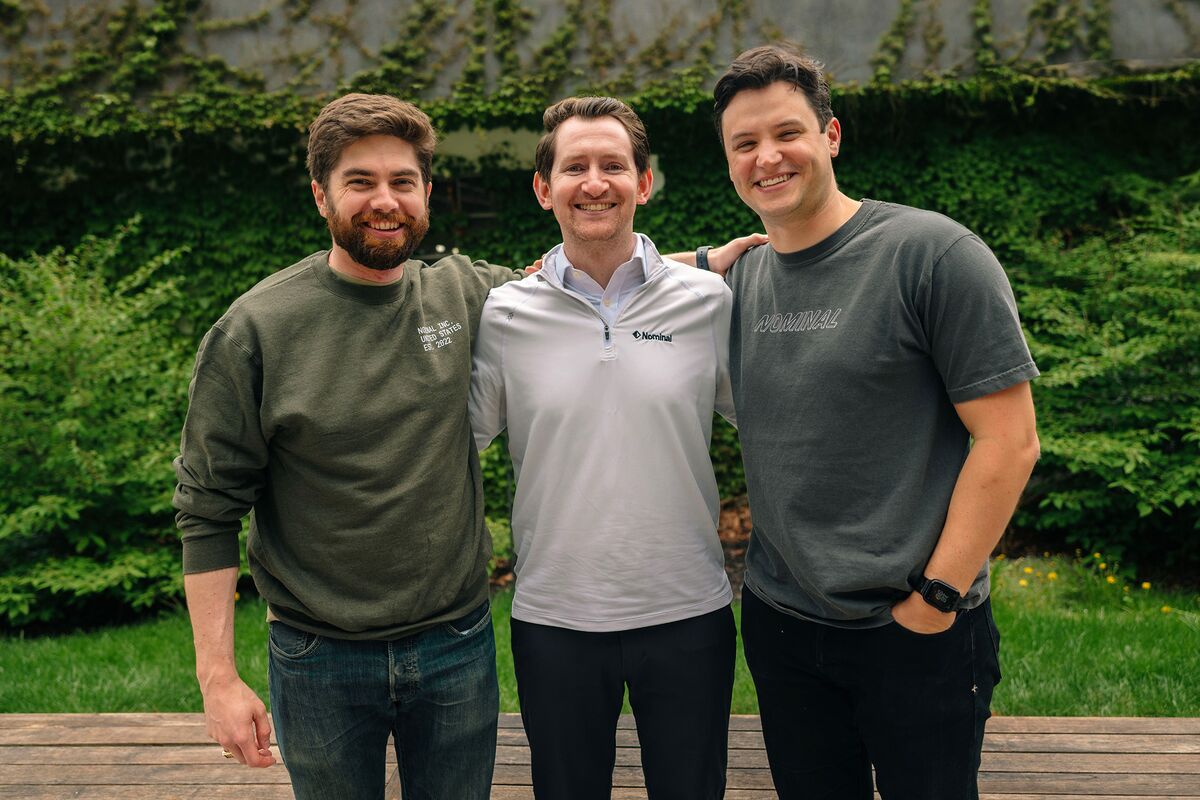
Cameron, Jason, Bryce, and the entire Nominal team: congratulations on the Series C. We’re proud to be doubling down.
If you are an engineer who has lost a week debugging a test script, Nominal is hiring.
If you are running a hardware program and would like to know what you can learn from your test data, reach out today.
The content here does not constitute an offer to sell or a solicitation of an offer to buy any securities or investment advisory services.
The views expressed are those of the authors and do not necessarily represent the views or opinions of Lightspeed. Other market participants could take different views. Unless otherwise indicated, the inclusion of any third-party firm and/or company names, brands and/or logos are for representational purposes and does not imply any affiliation with these firms or companies and also does not imply their endorsement of the views expressed by the authors.
Certain information contained herein is based on information from various sources prepared by third parties. While such sources are believed by Lightspeed to be reliable, neither Lightspeed nor its affiliates assume any responsibility for the accuracy or completeness of such information, and such information has not been independently verified by Lightspeed. For more details please see https://www.lsvp.com/legal.
Authors