
The most valuable position in healthcare AI, we’d argue, belongs to whoever becomes the front door.
A few years ago, the live question in healthcare was whether AI would arrive at all. That question is settled. More than 80% of US physicians now use AI somewhere in their workflow; Doctronic, a company backed by Lightspeed, has facilitated nearly thirty million patient interactions where people received a medical answer from an AI rather than a human.
The new question in AI-enabled healthcare is how much the technology can help caregivers and patients. And of course, who builds the best experience in an industry not typically known for great experiences.
Healthcare resists a single sweeping take because it isn’t just one market. The five-trillion-dollar figure everyone cites is an aggregate. Underneath it sit hundreds of separate ten- and hundred-billion-dollar businesses, each with its own buyers, rules, and failure modes.
The way we try to keep our footing as investors (and physicians) is to anchor on what we believe is the one thread between them all, the atomic unit of healthcare: patients. Drive real patient impact, and the value tends to follow.
The patient journey map

Most people map AI in healthcare by technology: voice agents here, transcription there, imaging in another box. We’d rather map it by the journey a patient takes, because that’s where the friction sits.
It starts before anyone is sick. You have to get insurance coverage, which in the US is a real step and a consequential one, since how you get covered shapes everything downstream.
Increasingly, you try to stay ahead of illness rather than wait for it. When the illness comes anyway, you enter the traditional system: you find care and schedule it, you get seen, the visit becomes a record, the record becomes a claim, and somewhere through the back office someone gets paid. Around 80% of all appointment scheduling still happens over the phone, with the wait times and misrouting that implies. Many companies are now rebuilding each of these steps with AI at the center, from voice-driven intake to the medical coding that turns clinical language into the financial language of a bill.
Two facts about the map explain where we believe the venture opportunity is moving.
First, AI landed on the right-hand side of the journey: the administrative load, writing notes and cleaning up claims. We believe that was the right entry point for this emerging technology, where mistakes were common, and it’s not a small area: more than $1.2 trillion of the five trillion in US health spend is administrative.
Second, as the models improve, the work is moving left, toward the higher-stakes clinical end. Abridge, a Lightspeed portfolio company, is a great example of this. It first started as a leader in scribing, and recently unveiled its expansion toward a patient-centered clinician intelligence platform to help drive more value upstream. We are now spending far more of our time on the left side of the board, where patient trust, regulation, and reimbursement all still have to be earned.
Why we were willing to move left
When raw compute first looked capable of doing clinical work, the temptation was to back whoever could ship fastest. We looked instead for founders building the guardrails at the same speed as the capabilities, and working with state and federal regulators rather than around them. Two companies we backed sit at the autonomous end of that spectrum, as two form factors of the same idea:
Doctronic: the autonomous front door
Public-market history gives reason to be skeptical of consumer telehealth companies. Teladoc’s acquisition of Livongo is the cautionary tale investors reach for first. So where we focus our attention is what makes Doctronic much more than general-purpose chatbots and legacy telehealth offerings.
Two things: it was built to be HIPAA-compliant from day one, which is the price of entry for holding a patient’s trust and their data. And underneath the product is an exceptionally performant multi-agent, multi-model system that routes each step of the visit to the model best suited to it, rather than leaning on one general model to do everything.
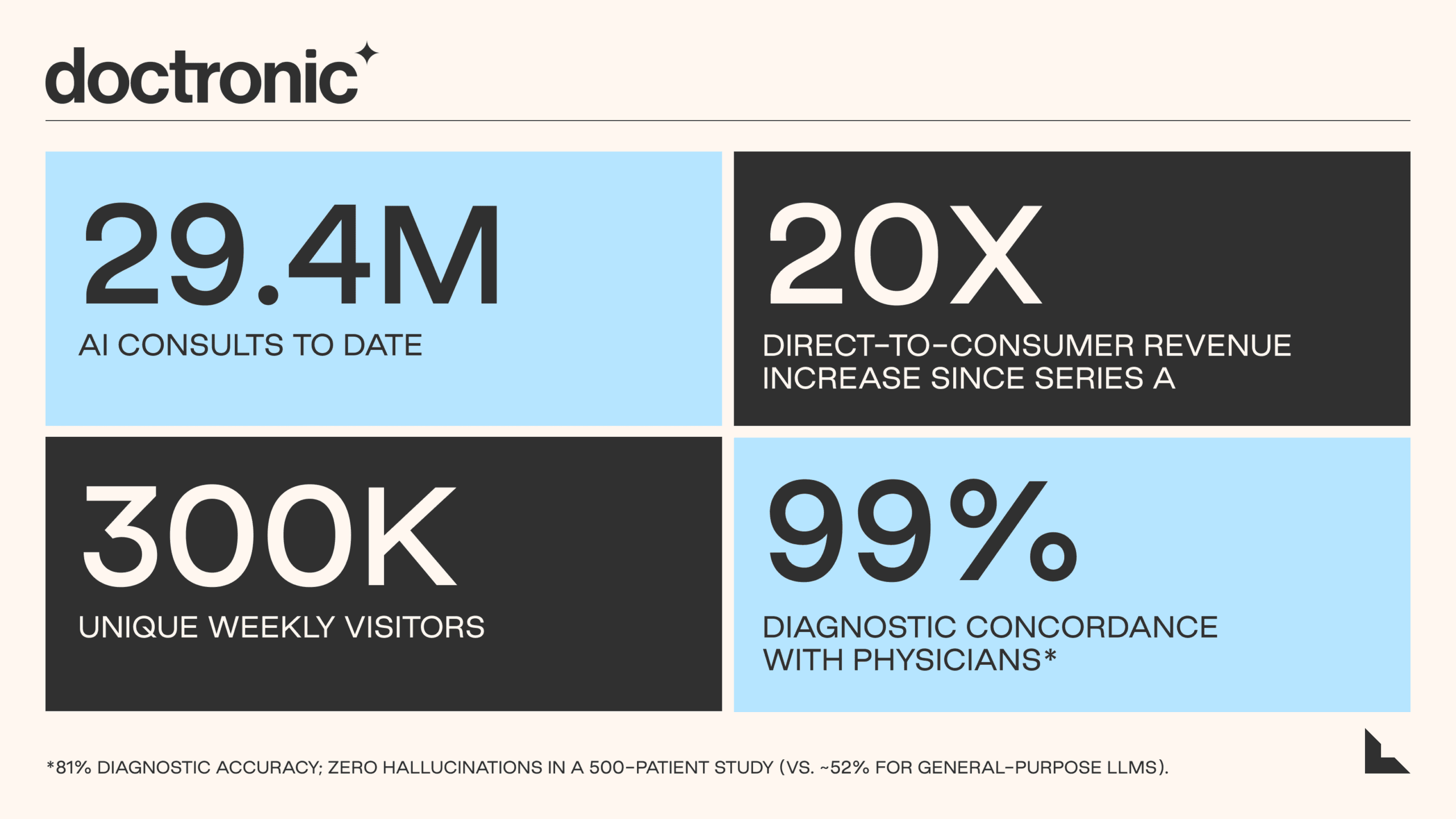
In Utah this year, Doctronic became the first US company cleared to renew certain chronic prescriptions autonomously, with no physician in the loop for that scoped task. In that pilot, 97%+ of prescription renewal decisions came back concordant with what a human physician would have made. That figure keeps climbing as the underlying models improve. The pilot’s success has already opened conversations at the state and federal level about how to expand access.
The momentum around Doctronic is real: nearly thirty million AI consults to date, direct-to-consumer revenue up over 20x since we led the Series A exactly one year ago, and the number-one “AI doctor” result on Google driving distribution around the best-in-class brand.
The regulatory lead strikes us as a near-term accelerant of this early distribution advantage. However, we believe the deeper moat is the flywheel underneath: patients appear to trust Doctronic enough to engage on sensitive health matters, the patient interaction data makes the care more personal and the outcomes often better, and better outcomes will help win over the pharmacies, health systems, and payers who extend the offering to their own patients. Doctronic could then become an agentic front door to healthcare.
Neko: the preventative front door
Neko sits at the other end of the journey, and it makes a deliberately contrary bet: proactive instead of reactive, physical in addition to digital.
More than three trillion of that five-trillion-dollar spend goes to clinical services that too often arrive late, on incomplete data. With Neko, you walk into a clinic and get scanned to create a baseline record of your health that forms the basis for personalized and preventive care.
From the outside, it reads as a premium consumer experience. Under the hood is something much more complex and ambitious: a vertically integrated, multi-specialty exam at a fraction of the usual cost, generating an order of magnitude more data, at a higher patient satisfaction score than the alternative traditional clinical odyssey.
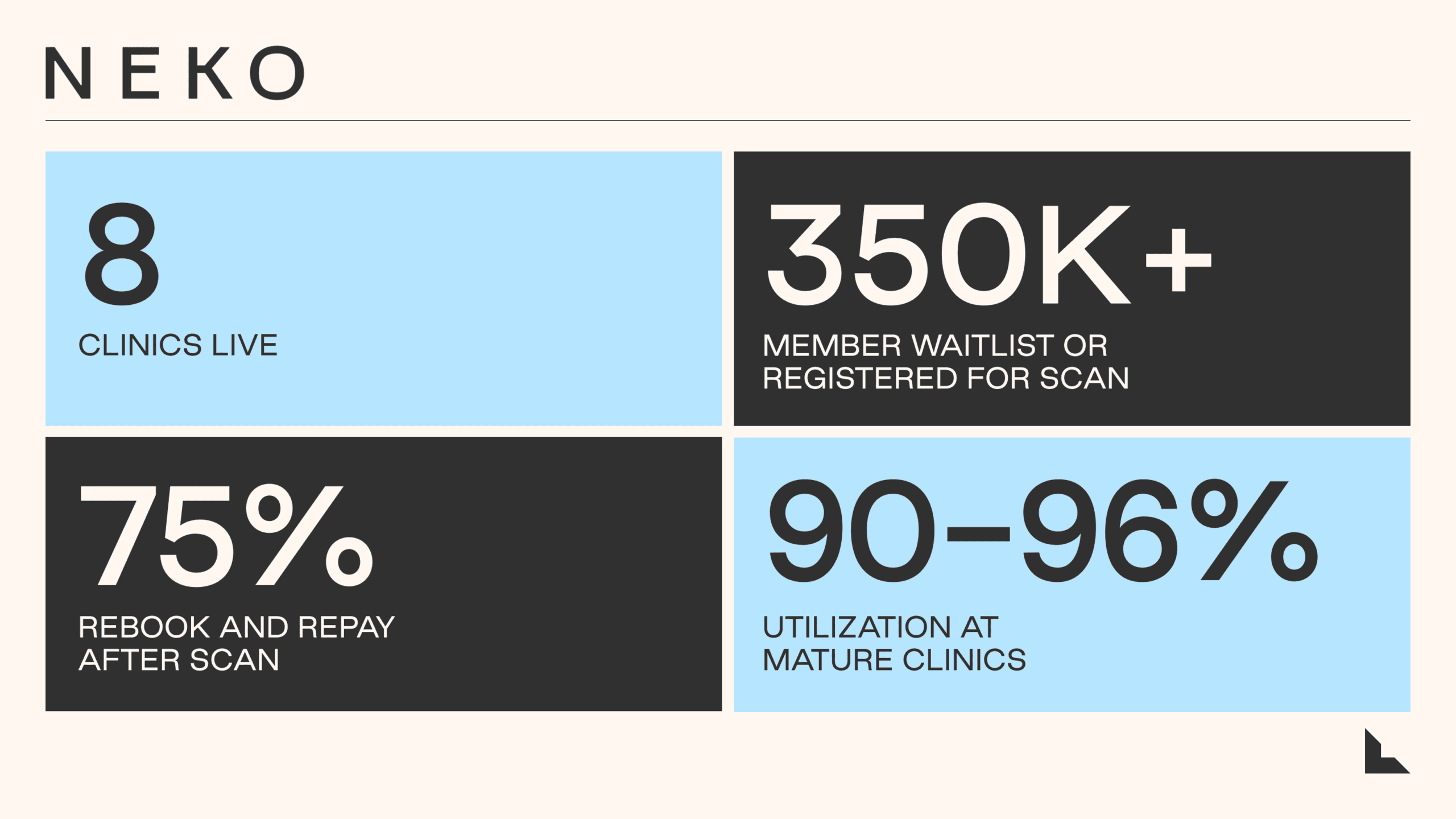
Daniel Ek and Hjalmar Nilsonne designed the hardware inside the clinic, which enables Neko to generate its own data, which in turn informs the care journey and yields proprietary insights that fuel clinical research and product innovation. The scan reads millions of data points, with the goal eventually being many orders of magnitude higher. Eight clinics are live, the first US location is coming to New York, and more than 100,000 people are on the waitlist to be scanned. One team did the scan in London for £300 and came away with a longitudinal read of our own body that almost no patient ever gets to hold.
The scan, though, is the beginning: Neko can become the gravity well for a person’s health data. Today, health data is scattered across portals and logins, locked away and nearly impossible to assemble, even for a motivated patient. If prevention becomes a habit a person returns to year after year, the starting point of the journey becomes the place where all the downstream data collects. In this future, Neko intersects productively with traditional healthcare too – a specialist would likely be excited to see a Neko patient is on their schedule, because their health data arrives packaged, contextualized, and ready to act on.
Two sides of one coin
Reactive and proactive look like two businesses, but we believe they’re two sides of the one coin: own the moment a person first turns toward the healthcare system, and you shape everything that happens after. Both Doctronic and Neko serve the patient as the buyer, choosing and paying directly, and coming back because the experience earned it.
We believe accuracy, a regulatory head start, and the data loop can make clinical AI work where telehealth didn’t.
A few things would tell us if our thesis plays out: if the autonomous lane keeps widening, if the tasks a regulator will let an AI perform without a human grow year over year, and if accuracy holds up as it expands further. We’ll know we’re wrong if, for example, accuracy stops converting into clearance, a safety failure freezes regulators’ appetite, or a frontier lab finds a way to collapse the trust-and-licensing advantage.
What could come next? Clinical AI has moved from interpretive work, like reading an image and offering a diagnosis, toward consultative. We believe the frontier from here is procedural and eventually surgical, which will be the point where AI stops living entirely in software and starts physically helping the human body. That end of the journey is years of regulatory and engineering work away. However, we believe the companies that become leaders in that future are the ones actively laying the groundwork for it today.
The content here does not constitute an offer to sell or a solicitation of an offer to buy any securities or investment advisory services.
The views expressed are those of the authors and do not necessarily represent the views or opinions of Lightspeed. Other market participants could take different views. Unless otherwise indicated, the inclusion of any third-party firm and/or company names, brands and/or logos are for representational purposes and does not imply any affiliation with these firms or companies and also does not imply their endorsement of the views expressed by the authors.
Certain information contained herein is based on information from various sources prepared by third parties. While such sources are believed by Lightspeed to be reliable, neither Lightspeed nor its affiliates assume any responsibility for the accuracy or completeness of such information, and such information has not been independently verified by Lightspeed. For more details please see https://www.lsvp.com/legal.
Authors