AI is eating the world–and the world’s energy along with it.
The numbers are staggering. Demand for AI compute is growing at unprecedented rates, and some projections hold that computation will be constrained by global energy supply within 3-4 years. NVIDIA’s latest GPUs consume over a kilowatt each. We’re scaling on power and cost, not efficiency. Meanwhile, the human brain–the original neural network–runs on a mere 20 watts.
To us, that gap represents one of the largest opportunities in technology.
The history of computing shows us that each major price and efficiency reduction has expanded applicability. Computers went from military and scientific tools to business applications to gaming to AI. We’re now at another inflection point. We believe AI is fundamentally different from prior forms of computation–it’s redefining productivity itself, moving computers beyond mere organizational tools. The breadth of AI’s applicability means demand will only accelerate.
What got us here won’t get us there. Moore’s Law is effectively over. Modern computing architecture has remained largely unchanged for 60+ years. We’re 10 billion times less efficient than the theoretical Landauer limit. There’s enormous headroom–if we’re willing to rethink the foundations.
Enter Unconventional AI.
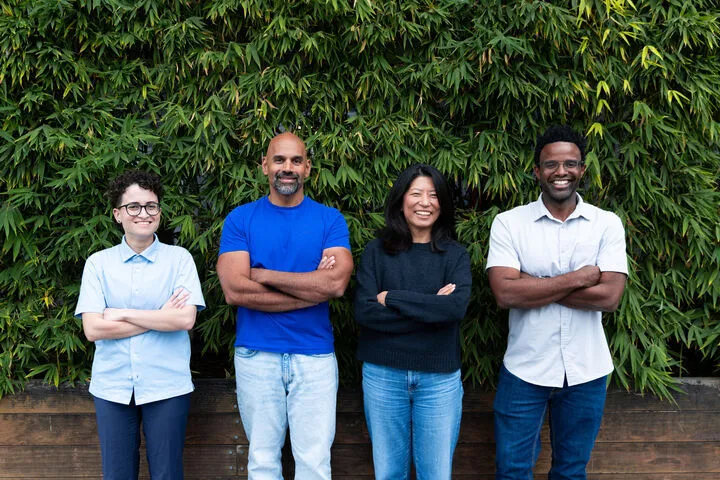
Founded by Naveen Rao, MeeLan Lee, Sara Achour, and Michael Carbin, Unconventional is building a new substrate for intelligence. Their insight: neural networks already have a biological analogue. Rather than simulating physical systems on digital computers tuned to emulate digital behavior, can we run neural networks on the physics directly? Can we build silicon circuits that demonstrate similar non-linear dynamics to biological neurons?
The goal is biology-scale energy efficiency. By finding the right isomorphism for intelligence, they aim to unlock efficiency gains far beyond what’s possible by iterating on conventional architectures.
This is not incremental improvement. It’s rethinking the computing model, the physical abstractions, and the physical implementation from first principles. Most AI hardware companies focus on microarchitecture or instruction sets. We believe Unconventional is going deeper.
The founding team is purpose-built for this challenge. Naveen previously founded Nervana (acquired by Intel) and MosaicML (acquired by Databricks). He left what could have been an incredible run and mission at Databricks because he believes this is a once-in-a-generation opportunity. MeeLan brings decades of analog circuit design from Google, Qualcomm, and Intel. Sara and Michael are leading researchers at Stanford and MIT, respectively, with deep expertise in programming novel computing substrates–analog devices, quantum systems, neuromorphic architectures.
We’re thrilled to be leading this round alongside Andreessen Horowitz, with participation from Sequoia, Lux Capital, DCVC, Jeff Bezos, and others, including significant investment from Naveen himself.
The mission is audacious, but the timing is right. AI workloads have a homogeneity that lends itself to specialized compute. The scale of demand means large R&D investments are not just justified but a necessity.
Over the next decade, while we’re busy building on this incredible AI wave, we believe we’ll have Unconventional to thank for making it energy-feasible.
Be Unconventional!
Authors