05/28/2026
AI
The Developer Platform for World Models: Our Series A in Reactor
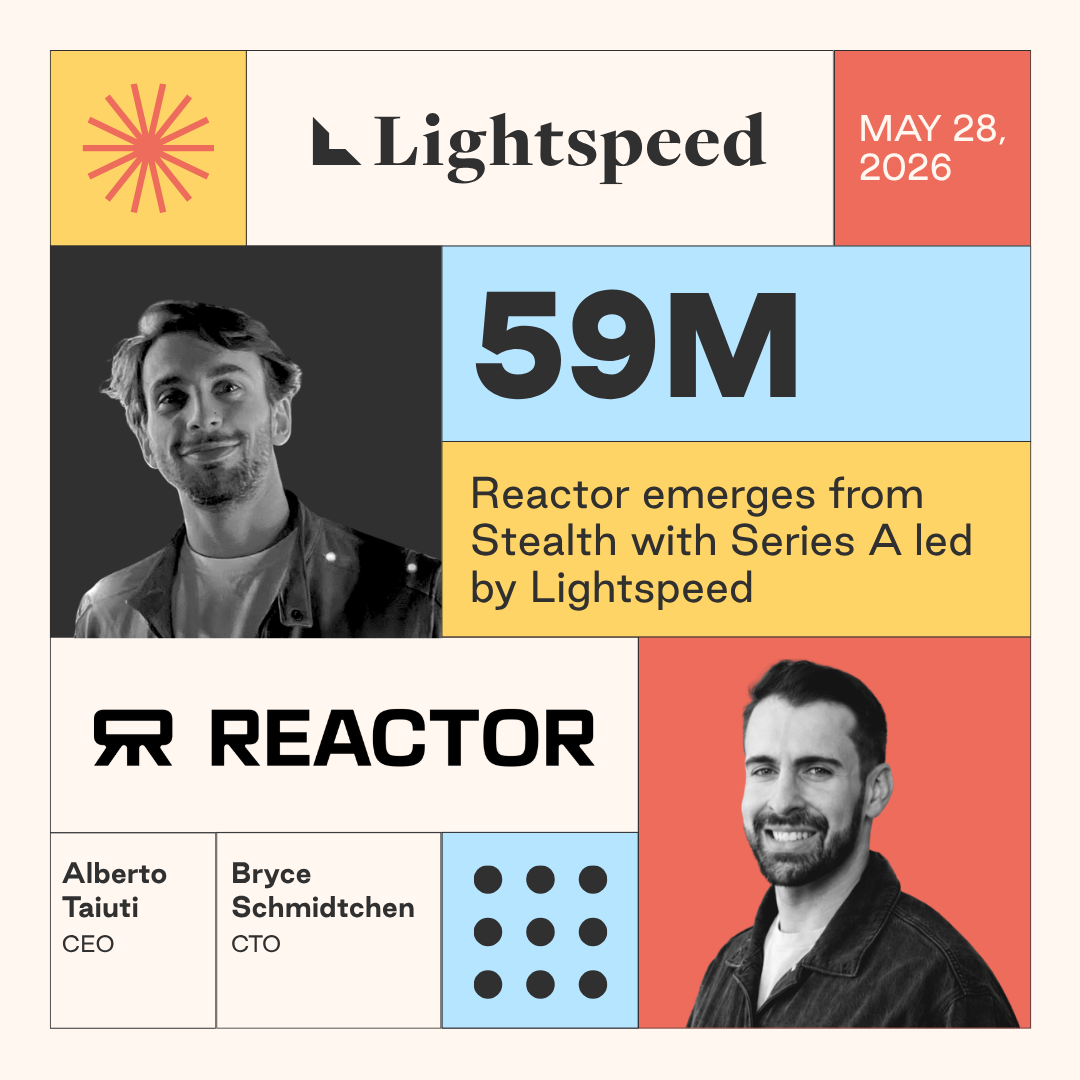
Today, Lightspeed is announcing we’re leading Reactor’s Series A after co-leading their Seed — $59M in combined funding — to further their goal of becoming the de facto inference platform for real-time video models. In the six months since their Seed round, Reactor is enabling a new generation of interactive AI applications across media and entertainment.
In 1878, Eadweard Muybridge settled a bet for railroad magnate Leland Stanford by rigging a series of cameras along a racetrack in Palo Alto. When the horse galloped through, each camera tripped in sequence and produced 24 photographs that, played back rapidly, showed something no human eye had ever consciously registered: all four hooves leaving the ground simultaneously. It was the proof of concept for motion pictures, but the insight was the frame rate, not a change in the physical camera.
The Frame Rate Shift
Generative AI for video is moving through a similar progression. The first wave of image generation: diffusion models producing a single static output from a prompt are Muybridge’s individual photographs. Remarkable on their own, but discrete and frozen. The second wave, text-to-video models changed the frame rate: motion is implied, but it’s pre-rendered, not interactive, and the loop is fixed.
What’s coming next is real-time interactive video models that respond to inputs mid-generation and maintain state across thousands of frames at sub-100ms latency. This would be the equivalent of cinema itself, not just a faster version of the prior thing, but a categorically different medium, with categorically different infrastructure requirements.
Research is moving fast, but infrastructure hasn’t caught up.
The research has arrived faster than anyone expected. Google DeepMind’s Genie 3 generates interactive 720p worlds at 24 FPS, StreamDiT achieves 16 FPS text-to-video generation on a single H100, and CausVid reaches 9.4 FPS with streaming inference. Yet these all remain research implementations that are impressive demonstrations of what’s coming for developers as APIs are not available yet. In order to build on top of these models today, you’re either self-hosting on H100s/A100s or waiting for an inference provider like Reactor to pick them up. This is a fairly common pattern in the physical AI and generative video space right now. Research is moving fast, but we’ve seen that the infrastructure layer to actually build products on top of it hasn’t caught up.
The Team
Founded by long-time friends, Alberto Taiuti and Bryce Schmidtchen met while working together on the early Vision Pro team at Apple on video models and infrastructure. Alberto then went on to start his first company as the CTO and co-founder at Luma AI, powering image and video generation for creatives at scale. Bryce spent years mastering kernel optimization and cutting-edge computer vision for AR/VR.
Together, Alberto and Bryce are a perfect team to help catch the massive wave of real-time video applications with their technical depth and foresight on how developers will build with these models.
What Reactor Builds
The current AI infrastructure landscape is dominated by inference platforms for LLMs, which are optimized for single-shot generation: you send a prompt, get a result, and the session ends. Diffusion serving platforms are centered around discrete generation requests rather than continuous interactive sessions.
Real-time video models require fundamentally different infrastructure than the one for any current modality: persistent state across interactions, bidirectional streaming with sub-50ms latency, real-time control input processing, and session orchestration that maintains consistency across thousands of generated frames. The current technical gap between optimizing them and building true real-time interactive experiences is substantial. So much so that it has become one of the primary bottlenecks preventing these models from being more widely adopted. If we can fix this, we believe it opens the floodgates to an entirely new world of gaming, entertainment, and physical simulation applications.
This is where Reactor comes in. Alberto and Bryce’s experience enabled them to spot the opportunity that this paradigm shift represented early on and see how critical new infrastructure would be to enabling it.
The core insight of Reactor’s platform lies in how easily it enables developers to build real-time video experiences. They abstract away GPU provisioning, infrastructure setup, and streaming complexity, freeing developers to build with real-time video models in their programming language of choice. Unlike existing video model serving platforms optimized for throughput-oriented batch inference, Reactor is built for low-latency and interactivity. In practice, this means <50ms frame latency. While this may seem subtle, it tends to be the difference between realistic video experiences and clunky demos not fit for production use.
In addition to its globally available infrastructure platform, Reactor’s team is deeply technical and purpose-built for taking research-grade open-source models (many of which are SoTA) and making them production-ready through ML layer improvements, custom CUDA code, and torch optimizations. The combination of Reactor’s infrastructure and model optimizations is realistic, interactive, real-time video experiences now available to anyone.
Why We’re Doubling Down
This made co-leading their seed an easy decision for Lightspeed. Today, we’re doubling down in response to the progress they’ve made in a short period across hiring, product, and ecosystem partnerships.
We are thrilled to partner with Alberto, Bryce, and the incredible team behind Reactor in their mission to bring real-time video experiences to all.
If interested in learning more about open roles, they are hiring!
The content here does not constitute an offer to sell or a solicitation of an offer to buy any securities or investment advisory services.
The views expressed are those of the authors and do not necessarily represent the views or opinions of Lightspeed. Other market participants could take different views. Unless otherwise indicated, the inclusion of any third-party firm and/or company names, brands and/or logos are for representational purposes and does not imply any affiliation with these firms or companies and also does not imply their endorsement of the views expressed by the authors.
Certain information contained herein is based on information from various sources prepared by third parties. While such sources are believed by Lightspeed to be reliable, neither Lightspeed nor its affiliates assume any responsibility for the accuracy or completeness of such information, and such information has not been independently verified by Lightspeed. For more details please see https://www.lsvp.com/legal.
Authors