10/22/2026
AI
“You can actually have a full organization running with agents and a finance team of two.”
Santiago Nestares, co-founder and CEO of DualEntry, on tapping into accounting’s full potential, what legacy ERP platforms got wrong, and how AI gets data implementation done in a day instead of months.
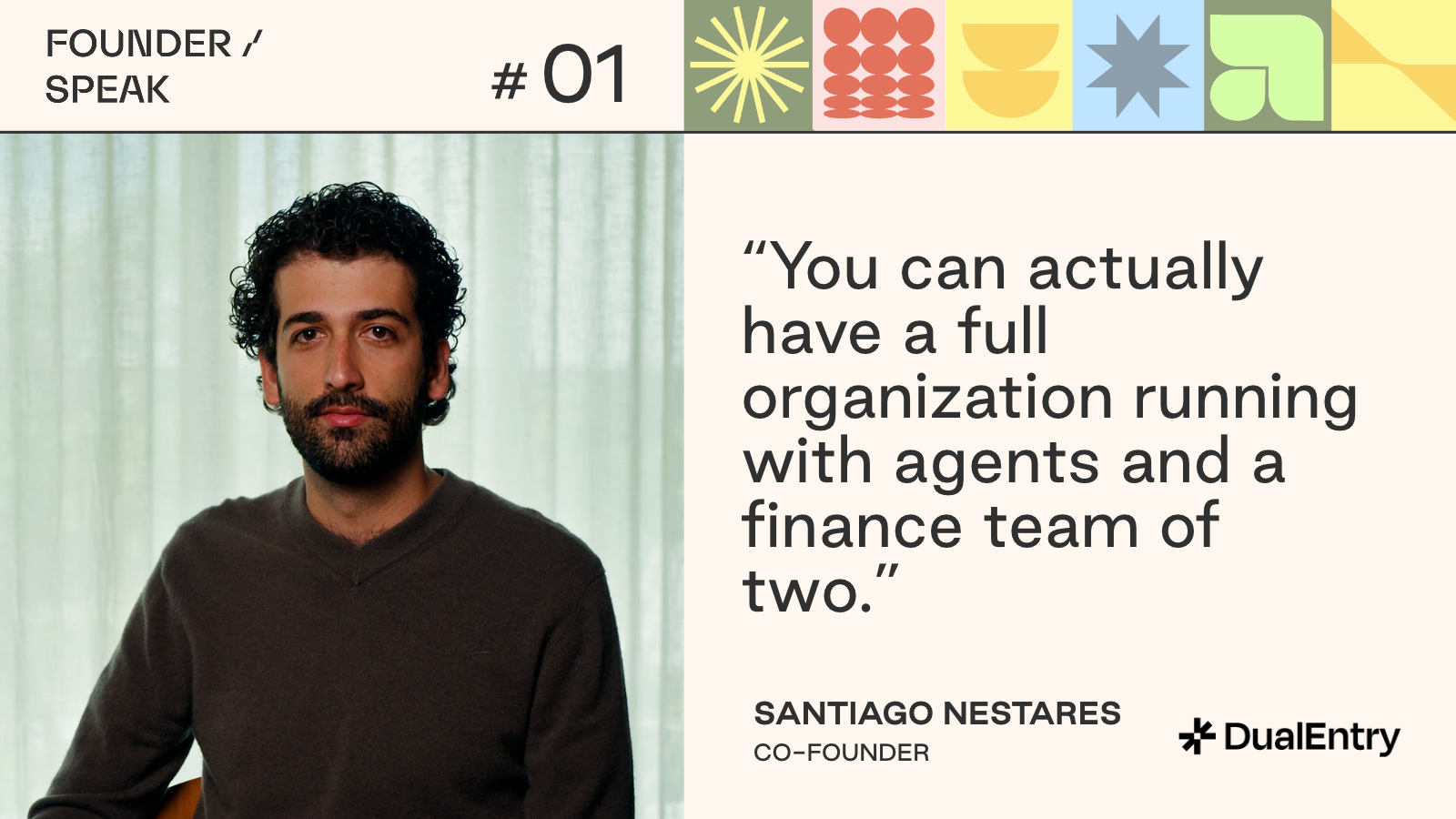
Less is more for Santiago Nestares. As the co-founder and CEO of New York–based DualEntry sees it, the key to successful accounting software is minimizing the time spent on tedious workflows. As a founder, Santiago experienced the problem firsthand while working through outdated legacy systems. So he set out to build an alternative. The result is customizable software built to scale, with time-saving automations powered by AI models. But automating manual tasks is just the start: With more time and computing power, founders can unlock real-time data and understand the stories in the numbers. And leaner teams and a streamlined workflow can mean lower expenses, a major asset for companies ranging from the mid-market to those preparing for an IPO. In a conversation with Claire Zau, Santiago spells out why accounting has historically fallen short of its full potential. Sure, it is an asset for closing the books, but what about truly understanding the business?
This interview is part of a Lightspeed feature called Founder Speak. In this series, Claire Zau introduces you all to an AI expert who is making waves in the industry. Here, “founder speak” means honest conversations with tech leaders, plain and simple. Recent guests include Yoav Levine of Double AI and Naveen Rao of Unconventional AI. Claire is a Lightspeed Partner and co-host of our podcast, Lightwork.
Claire Zau: I am so excited to be here with you. Can you explain what you are building, especially for someone who’s never actually thought about accounting software in their lives?
Santiago Nestares: So DualEntry is an AI-native ERP, and it is also a word used for accounting software; think of it like the place where you plug in every other system in your company. It’s where the ultimate source of truth of how your business is performing lives. You can have tools that give you some predictions, but nothing is a true report card until you get your P&L statement and balance sheet and cash flow statement from your accountant. DualEntry enables you to get that data in real time, as opposed to having to wait for a close. We give insights that will actually help make your business better, from early-stage Series A companies to publicly traded companies. We believe that you can scale the company past $100 million without having to add more people to your finance teams.
Claire: How would you describe what you do to someone outside of the industry?
Santiago: Think of accounting software as the report card for a business. It’s what tells you how well you’re doing and doesn’t leave out any data point.
Claire: In your opinion, as someone who’s interfaced with platforms like NetSuite, what is the single dumbest thing these ERPs do?
Santiago: Accounting is one of the few functions that has been convinced by this legacy ERP that closing your books or getting it done is not actually delivering any value. So it has become so cumbersome that accounting is the only vertical, the only department in the company that actually calls closing your books getting the job done. Think of it like in sales: If a salesman came up to you and said, “Closing your books is when you update HubSpot or Salesforce,” that’s not actually getting the sale done. And accountants have so much power. They’re so smart, and they can actually go in and look at the books to ultimately deliver an insight to the board that says, “Hey, you should double down on this investment, or you should cut back on this wasteful thing that we’re doing.” Yet we’ve somehow been convinced by these legacy ERPs that actually just getting the data input right is the full extent of your work, and people don’t want to be caught up in that.
Claire: Why do you think that founders hate some of the legacy platforms like NetSuite and ultimately killed it?
Santiago: For my last company, I was looking to implement in Europe because we’re growing very quickly, and the thing that made me hate NetSuite is the fact that there had never been an alternative, so they could get away with charging you ridiculous prices, not giving you a full demo, not letting you use the software before you buy it, and then getting you caught up with these implementation teams internally that are just there to squeeze you a few more hours. And these are things that you would never, as a tech founder, want for your own company. But you simply didn’t have an alternative other than something like a NetSuite–until now, where you can pick DualEntry in Europe, and it’s going to get that implementation done in 24 hours instead of 18 months.
Claire: That brings us to DualEntry, which is an AI-native ERP. What does AI help unlock for your platform?
Santiago: Once we get rid of this notion that we’re just going to get the books closed, then you can take action on whatever insight you can get from your books. So if you look at how our accounting organizations are structured today, most organizations have junior accountants who do repetitive tasks that then get sent to senior accountants for approval. A lot of these repetitive tasks can now be done by an AI agent, where if you give it the right context and guardrails, it can only access the appropriate data, then it creates the output and runs it through an approval process. You can actually have a full organization running with agents and a finance team of one. Two, because every transaction needs a preparer and a separate approver. That’s segregation of duties, and it’s what auditors look for. So DualEntry today has thousands of users. Some of our customers have more than $100 million in revenue with a two-person finance team. That would have been impossible six months ago.
Claire: That’s insane. I’m going to ask you, what’s the first thing you did after raising a $90 million Series A?
Santiago: We bought new laptops.
Claire: Nice. Okay, I love that.
Santiago: We took the money and started opening new verticals, started hiring, came up with new ways to go and spread the word about DualEntry. The problem when we started was that we could only serve a small subset of our customers because we wanted to make sure they had a 10-out-of-10 experience. With this $90 million, we can now go after more verticals. And if you really want to give an alternative to legacy options, you have to give an alternative across the whole board, whether you’re a real estate company, a tech company, or a manufacturing company.
Claire: Amazing. As a second-time founder, what is something you would tell your 19-year-old self?
Santiago: I would tell my 19-year-old self: Go big or go quicker. You know, you only live once. When you’re young, you have the most energy, and you have this notion that somehow people who are 10 years older than you have it all figured out–I’ve always found that to be only partly true. Honestly, nobody knows what they’re doing most of the time. You can gain experiences by trying new things. So go pick a bigger problem, and don’t be shy: Go solve it, and you’ll probably fail a few times, but you will eventually see it through and come up with a solution that’s meaningful to the world.
Claire: Okay, last question: Do you have a book you recommend to other founders or someone who’s looking to understand the space?
Santiago: So I have a contrarian answer to this one: You should actually not read a book, but go out and try something new in the real world. You’ll learn a lot more by bumping your head against different walls than what you’re going to learn about from reading books. I had this chip on my shoulder where I felt I didn’t know anything, so I read hundreds of books to try to level up, to be on par with other founders that were, maybe, five or 10 years ahead of me. Then I realized that, sometimes, books become a good excuse for not taking action; it’s almost like a sedative. When you’re reading business books, you feel productive, but you’re going to learn the most if you go out there and just try something new.
The content here does not constitute an offer to sell or a solicitation of an offer to buy any securities or investment advisory services.
The views expressed are those of the authors and do not necessarily represent the views or opinions of Lightspeed. Other market participants could take different views. Unless otherwise indicated, the inclusion of any third-party firm and/or company names, brands and/or logos are for representational purposes and does not imply any affiliation with these firms or companies and also does not imply their endorsement of the views expressed by the authors.
Certain information contained herein is based on information from various sources prepared by third parties. While such sources are believed by Lightspeed to be reliable, neither Lightspeed nor its affiliates assume any responsibility for the accuracy or completeness of such information, and such information has not been independently verified by Lightspeed. For more details please see[ https://www.lsvp.com/legal](https://www.lsvp.com/legal).