Warp builds AI-driven robotic labs that run drug discovery chemistry for pharma and biotech companies. Its goal is to both speed up drug discovery and bring this work back to the US.
Warp launched today, and Lightspeed led its Series A.
Drug discovery is slow because lab work is slow
Deloitte estimates that the 20 largest drug companies spent an average of $2.23B per approved drug in 2024, including the cost of drugs that failed. Only about 1 in 10 drugs that enter human trials get approved. For cancer drugs, that ratio goes to about 1 in 20.
A large part of the early work is chemistry. Before a drug candidate enters trials, chemists refine and improve it through thousands of variations in a stage known as lead optimization. In each round, a chemist designs a new version of the molecule, then a team makes, purifies, and tests it, and the results shape the next design. Good contract labs aim to finish a round in two to three weeks. A full program usually takes 2-4 years.
Even when AI models are able to suggest better molecules, there’s a clear challenge to overcome: AI can only speed up drug discovery as much as the lab can keep up. Each suggestion still has to be made and tested in a lab before anyone trusts it.
A 2026 analysis of lab automation found that a chemist doing synthesis by hand rarely runs more than about ten reactions a day, and each handoff between steps adds more wait time. A bigger challenge is that this work doesn’t compound. The learnings from each experiment, and each chemist, don’t lead to process expertise that compounds and improves automatically.
This is why we believe Warp Sciences’ work is so essential.
Today, most of this work is done offshore
Western pharma sends most of its outsourced chemistry offshore, largely to China. So much so that the two largest companies doing this work have a combined market cap close to $100B.
In a 2024 survey by the Biotechnology Innovation Organization, 79% of the 124 companies that responded had at least one contract with, or bought at least one product from, a China-based contract manufacturer. The largest of these companies earned about 65% of its 2023 revenue from US customers. Its US revenue grew 32% in the first nine months of 2025, to about $3.1B.
US policy is now pushing the other way. The BIOSECURE Act became law in December 2025 as part of the annual defense bill, limiting federal contracts and grants that involve “biotechnology companies of concern.” In June 2026, the Department of War added the largest offshore provider to its list of Chinese military companies. This is one of the first steps toward the BIOSECURE Act being enforced.
The ripple effects will be significant. Based on industry estimates, US companies could take up to eight years to replace these partners without disrupting their drug programs. Pharma leaders have told the Warp team, and us, that they want a domestic option, but no US provider is currently built to do this work at that scale.
Lab data is missing the failures
At the same time, AI models for chemistry are also limited by the data they learn from.
Lab data often lives inside the companies that generate it. It’s also recorded in different formats; most of it was never captured in a form a model can use. To make things more complicated, published data leans toward successes, since reactions that fail or produce very little rarely get written up.
But failed experiments are some of the most valuable training data for a model. In a 2025 Science Advances paper, IBM researchers added failed reactions to a model’s training data, and the model got better at predicting reaction outcomes. It needed only 20 successful examples. In earlier work, a team at Haverford College used about 4,000 failed reactions to build a model that predicted how to make new crystals better than expert chemists did.
What Warp is building
Warp’s first service is lead optimization chemistry for pharma and biotech companies.
Early on, expert chemists will do much of the work. AI tools help them plan how to make each compound and pick the next experiment. Over time, robots will take over repetitive, high-volume steps, such as setting up reactions and purifying samples. Meanwhile, the chemists will spend their time on the hardest problems.
Each experiment produces robotics and process-engineering data as well as chemistry results. Warp records every step of every run in a form a model can learn from, including the steps that fail. Warp uses this data in two ways:
- To run the lab better. The data shows which steps are slow or unreliable, so the team can make them faster and cheaper.
- To choose what to make next. The data trains models that predict how to make a compound and which compounds are worth making.
Each new run adds to this data, so both uses improve over time. Because Warp’s own robots run the experiments, it also keeps the failed results that other labs rarely capture.
Later, Warp plans to sell predictions as well as compounds. A typical drug program makes thousands of molecules. If a model can point chemists to the best ones earlier, a program can reach the same result with fewer experiments.
Why now
We see three changes that make this possible today.
- Lab robots can now do this work. Researchers at the University of Liverpool ran a mobile robot chemist through 688 experiments over eight days. It worked 172 of the 192 hours. A newer self-driving lab design at NC State collects ten times more data and explores new chemistry at least three times faster than earlier versions.
- AI models can now help steer experiments. Large drug companies are connecting AI models directly to their labs. In January 2026, Lilly and NVIDIA announced an investment of up to $1B over five years for a joint AI lab in the Bay Area. Its first goal is a system that learns continuously from Lilly’s lab experiments.
- Customers and policy point the same way. Demand for a domestic option keeps growing, and the BIOSECURE Act adds a timeline.
The team
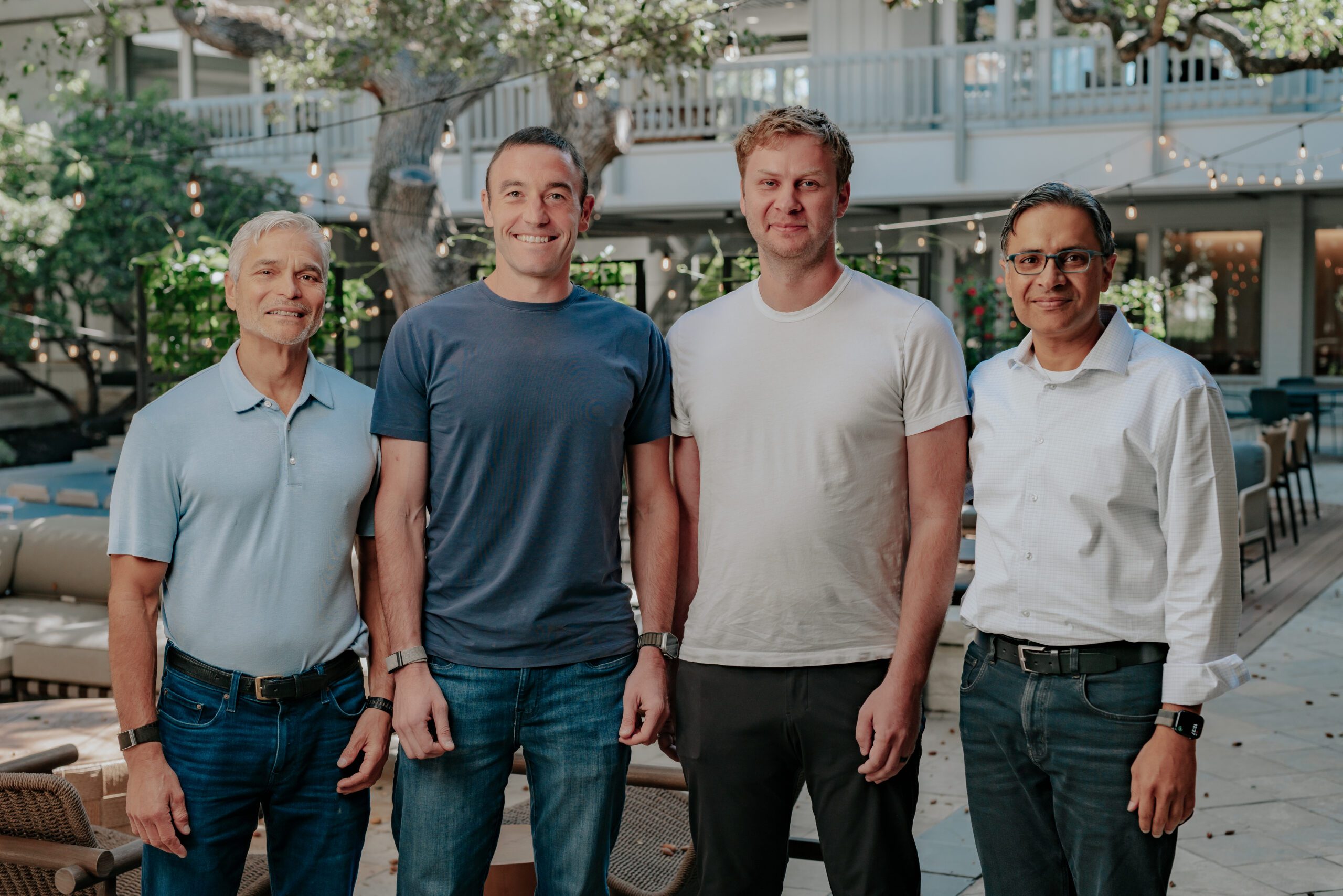
- Kevin Weil, CEO: We’ve known Kevin for nearly two decades and have great respect for him. His career has taken him to the frontiers of science and technology. He studied physics and math at Harvard and then physics at Stanford. He led product at Twitter and Instagram. He was President of Product and Business at Planet, which runs a large fleet of Earth imaging satellites. At OpenAI, he was Chief Product Officer, and then started and led OpenAI for Science. His team there released a life sciences model earlier this year. He spent his last year at OpenAI focused on making AI models better at science, including life sciences, the kind of work that led him to Warp.
- DJ Patil, COO: DJ was the first US Chief Data Scientist under President Obama. He worked on the Precision Medicine Initiative and helped set up chief data officer roles across federal agencies. Before that, he was Chief Scientist at LinkedIn, where he helped coin the job title “data scientist.” He later built technology at Devoted Health. He has deep experience in healthcare data and government.
- Sol Reisberg, CSO: Sol has led medicinal chemistry for about 20 years and has taken five drugs into the clinic. He worked at Gilead and Schrödinger and co-founded Terremoto Biosciences. He bought services from the offshore labs for years, so he knows what customers need from a provider and where those labs often fall short.
- Mano Paluri, Co-founder: Mano helped found FAIR, Meta’s AI research lab, and spent 14 years building AI at Meta. He led work on Meta’s Llama models and was most recently a VP at Meta Superintelligence Labs. At Warp, he leads the model and robotics work.
In Kevin’s own words earlier this year, prior to leaving OpenAI, he said: “The science of the future will definitely involve robotic labs and reinforcement learning loops that go through the real world.” He also said these labs can scale out and run 24 hours a day. Now, Warp is building those labs.
The early team also includes experienced medicinal chemists and roboticists, along with engineers from Lawrence Livermore National Laboratory and Genentech.
Why Lightspeed led
At Lightspeed, we’ve been researching the intersection of AI, Robotics, and Life Sciences for a number of years. AI-driven automation of the drug development lifecycle has been a priority investment focus for us. In our very first meeting with the team, it was clear how they were uniquely positioned to capture this opportunity and build a generational platform, and as a result, we committed to working with them in the very first meeting. We’ve worked with the team since then, bringing to the table our AI, robotics and life sciences experience. Shelley and Jonathan have spent decades in drug development, and Warp will draw on that as it works with its first customers.
Lightspeed has a history of backing frontier teams early. Now we’re doing the same with Warp.
Onwards
We’re thrilled to work with Kevin, DJ, Sol, and Mano on a critical mission for US biotech and patients waiting on new medicines.
Warp is hiring roboticists, AI researchers, and chemists. If you want to help build this, reach out at https://warp.xyz.
Welcome to Lightspeed, Warp. Onwards!
The content here does not constitute an offer to sell or a solicitation of an offer to buy any securities or investment advisory services.
The views expressed are those of the authors and do not necessarily represent the views or opinions of Lightspeed. Other market participants could take different views. Unless otherwise indicated, the inclusion of any third-party firm and/or company names, brands and/or logos are for representational purposes and does not imply any affiliation with these firms or companies and also does not imply their endorsement of the views expressed by the authors.
Certain information contained herein is based on information from various sources prepared by third parties. While such sources are believed by Lightspeed to be reliable, neither Lightspeed nor its affiliates assume any responsibility for the accuracy or completeness of such information, and such information has not been independently verified by Lightspeed. For more details please see https://www.lsvp.com/legal.
Authors